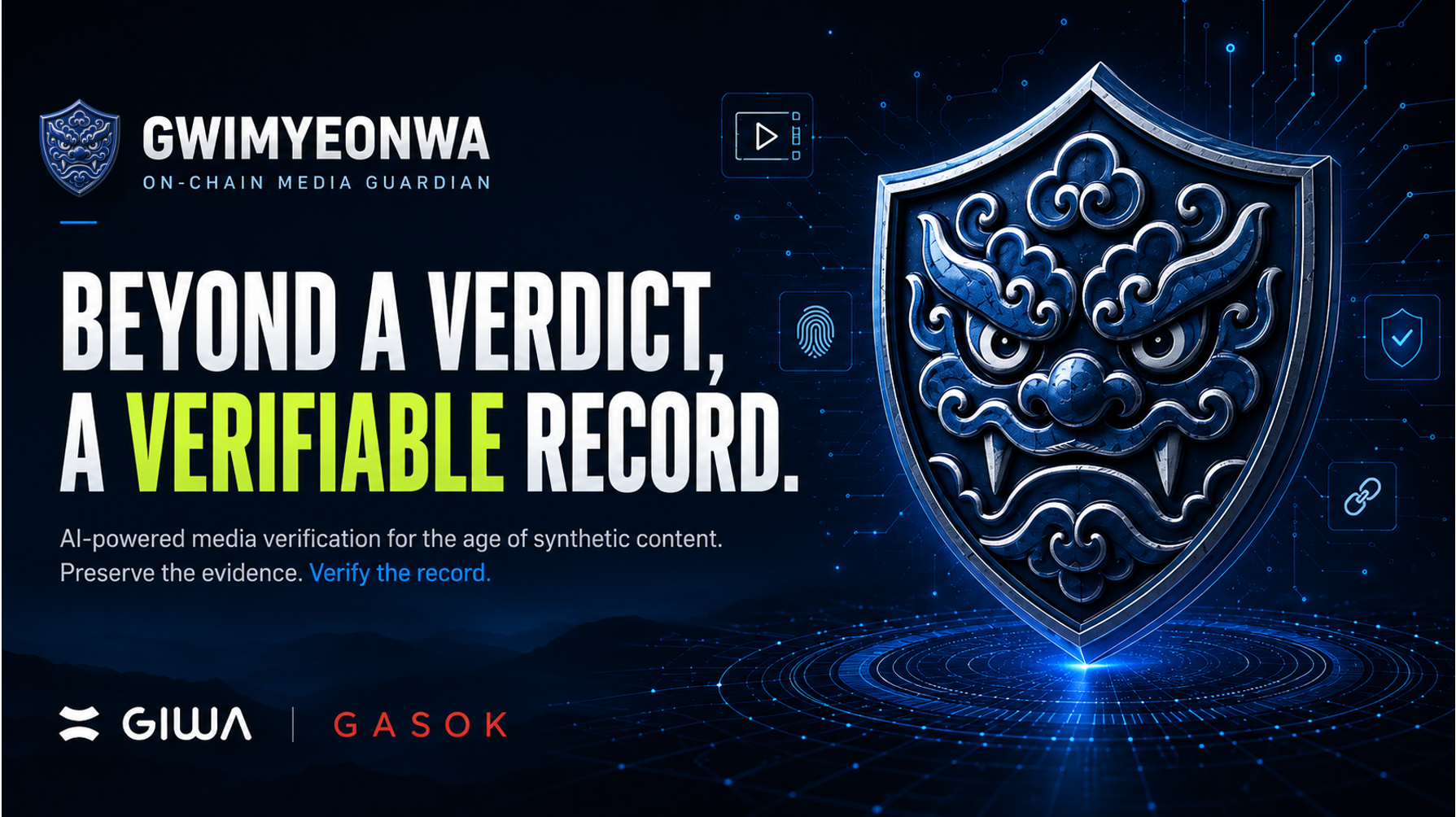
Detecting AI-generated videos, deepfakes, manipulation, and unsafe content is only the beginning. GWIMYEONWA is building a media verification layer where the evidence can persist, travel, and be independently verified on GIWA.
The internet is reaching a point where seeing something is no longer enough to believe it.
AI-generated video is becoming more realistic. Deepfakes can reproduce faces, voices, and behavior with increasing precision. Manipulated clips can spread before anyone has time to establish what actually happened. At the same time, platforms, brands, media organizations, and institutions face another challenge at scale: identifying violence, explicit material, and other unsafe content before it causes harm.
AI can help analyze these signals.
But there is a second problem that receives far less attention:
What happens after the analysis?
A system may conclude that a video is AI-generated. It may detect deepfake signals, manipulation, or unsafe content. It may return a confidence score or a detailed report.
Then, in many systems, the trail ends.
The result exists as an API response, a screenshot, or an entry inside a private database. Someone encountering that same media later may have no independent way to establish when the analysis took place, what evidence belonged to that analysis, or whether the record being shown today is the same record that originally existed.
GWIMYEONWA starts from a simple premise:
Media verification should not end with a verdict.
It should leave behind a verifiable record.
Built on GIWA. Accepted into GASOK.
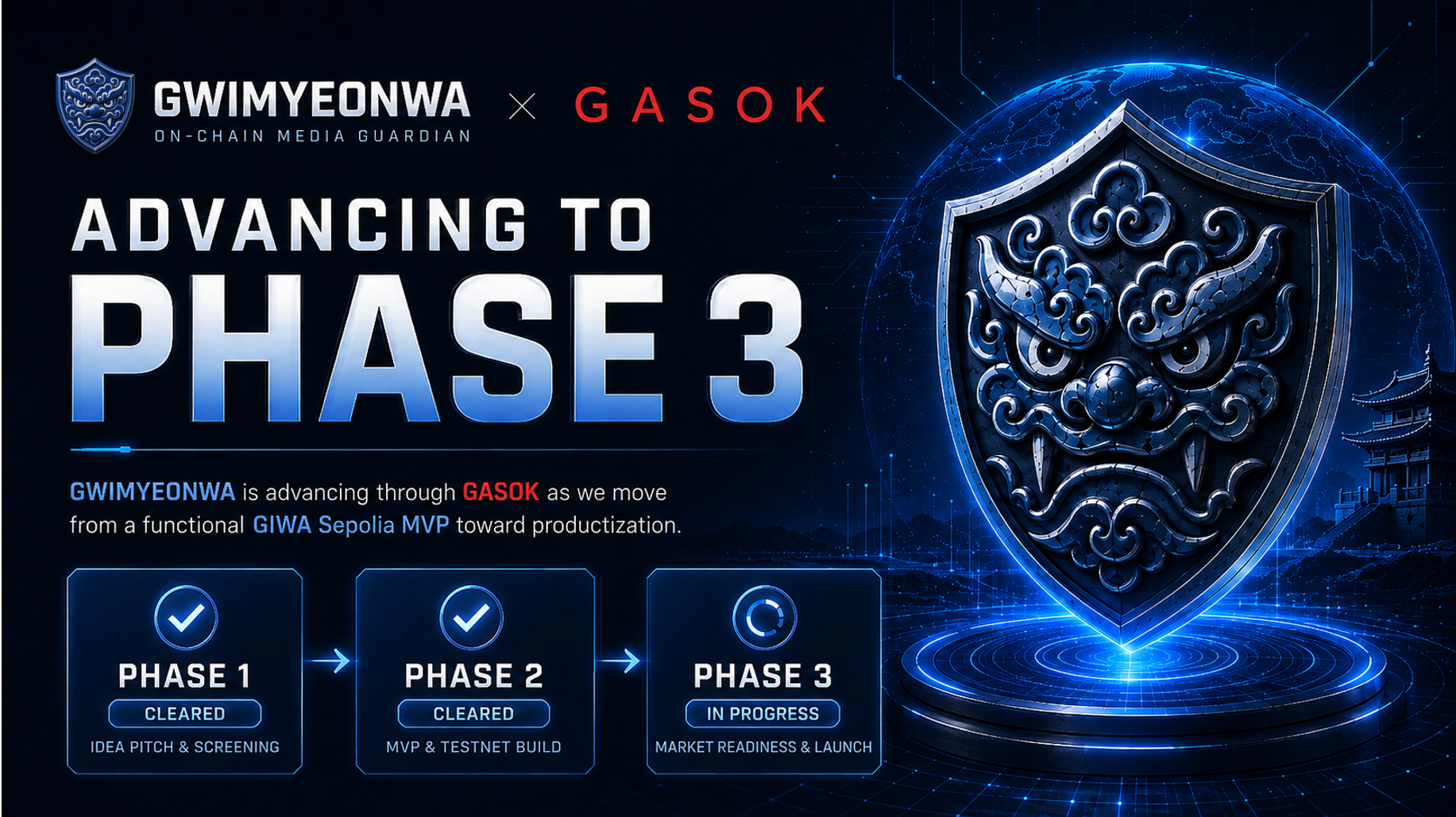
GWIMYEONWA has been accepted into GASOK(Phase 3), the builder program for the GIWA ecosystem, and is now advancing from a functioning MVP toward productization.
That matters because blockchain is not an accessory to GWIMYEONWA.
It addresses a specific problem in media verification: how can the evidence behind an AI analysis become persistent, tamper-evident, portable, and independently checkable?
GWIMYEONWA is being built natively around GIWA to answer that question.
The current product already operates on GIWA Sepolia. A user can analyze media, generate a verification record, create a cryptographic fingerprint of that evidence, anchor it through the GWIMYEONWA registry, and inspect the corresponding transaction on the GIWA explorer.
GASOK is the next stage: taking that working technical loop and turning it into something people, platforms, and organizations can use repeatedly. The existing roadmap moves from a live Sepolia MVP toward sharing and re-verification flows, API and batch workflows, partner integrations, and eventual mainnet-readiness evaluation.
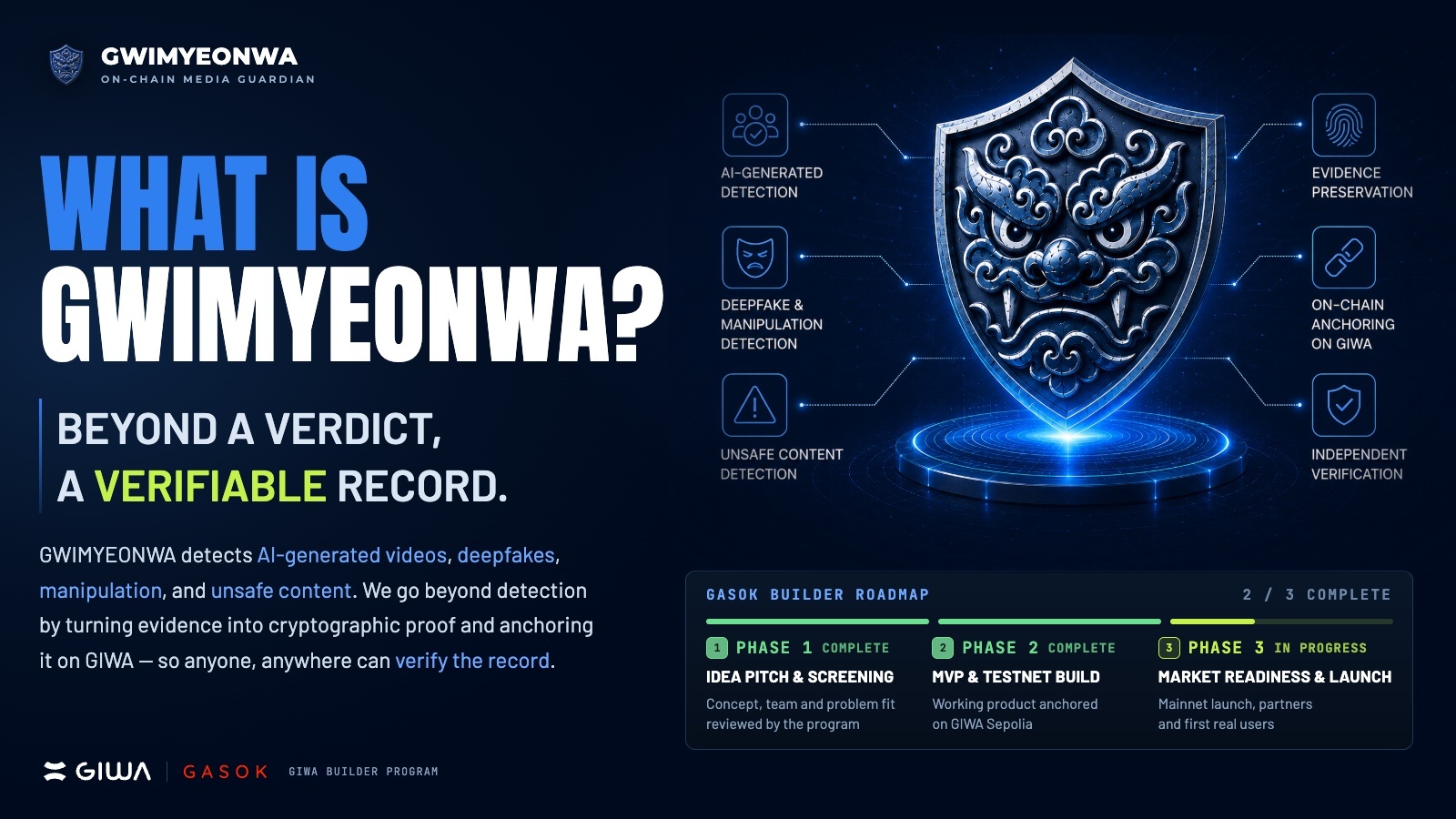
What is GWIMYEONWA?
GWIMYEONWA is a GIWA-native media verification protocol built to detect and assess:
AI-generated videos. Deepfakes. Manipulated media. Unsafe content.
But detection is only the first layer.
Once a piece of media has been analyzed, GWIMYEONWA structures the resulting evidence into a verification record and generates a cryptographic hash representing that evidence.
That hash can then be anchored on GIWA.
This creates something fundamentally different from a disposable AI response.
Instead of only saying:
“Our system thinks this video is fake.”
GWIMYEONWA can leave behind a record whose integrity can later be checked independently.
That is the distinction at the center of the product:
Beyond a verdict, a verifiable record.
GWIMYEONWA is designed to sit between conventional detection systems and provenance infrastructure: media is analyzed after it is encountered, while the resulting assessment is converted into a tamper-evident proof object designed for later re-verification.
Inspect. Seal. Verify.
The user experience is intentionally straightforward.
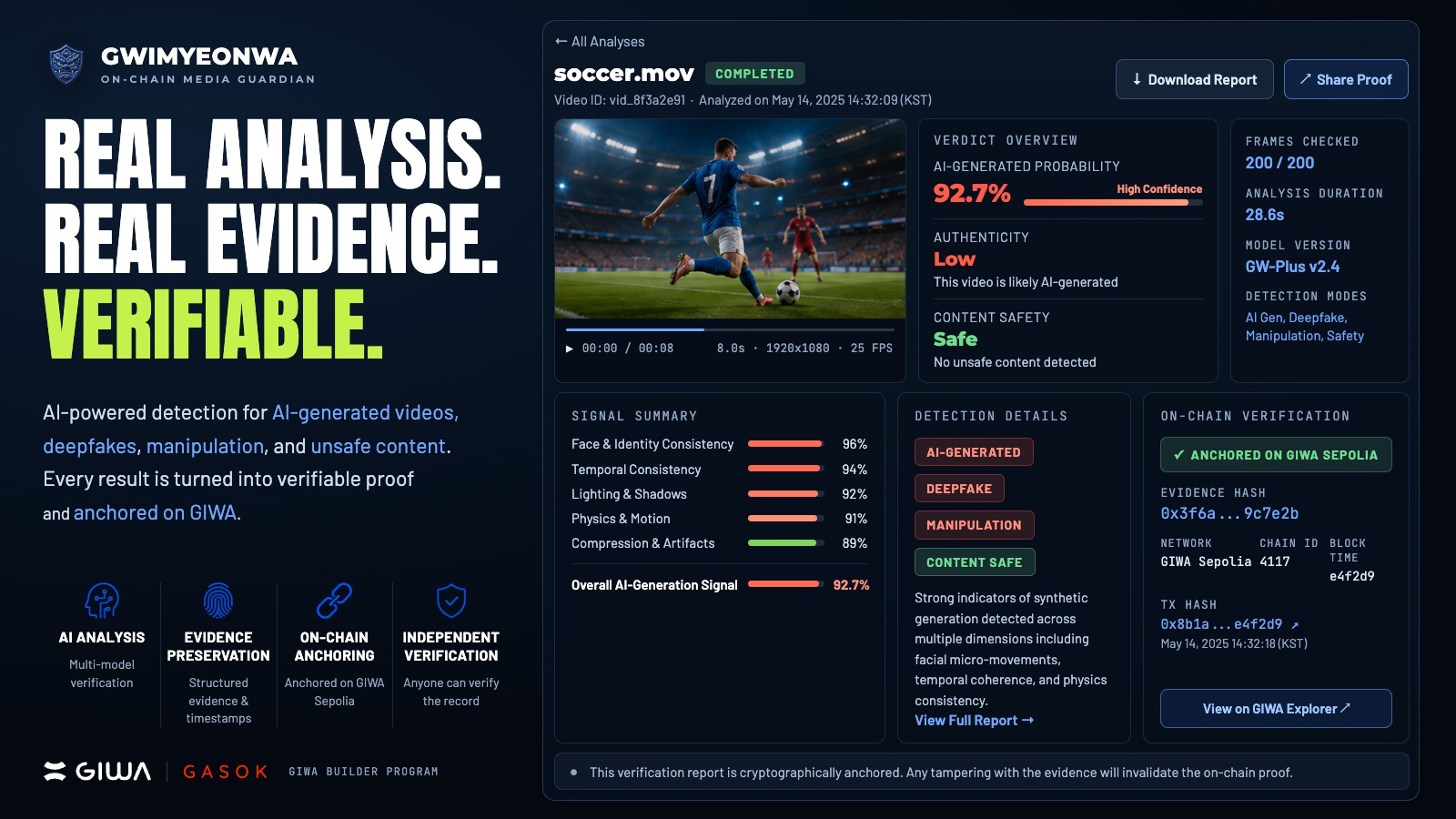
Inspect
A user submits a video to GWIMYEONWA.
The system analyzes the media across the video for signals associated with AI generation, deepfakes, and manipulation, while also evaluating content-safety risks.
Rather than returning only a score, GWIMYEONWA presents human-readable findings together with supporting signals from the analysis.
The objective is not merely to produce another opaque AI judgment.
It is to produce evidence that can be understood first — and preserved second.
Seal
When the analysis is completed, GWIMYEONWA creates a structured evidence record.
A cryptographic fingerprint is generated from that evidence.
Importantly, the original video does not need to be published on-chain.
The blockchain is not being used as a media-storage system. What is anchored is the evidence hash required to later test whether the verification record being presented still matches the record that was originally sealed.
The separation is deliberate:
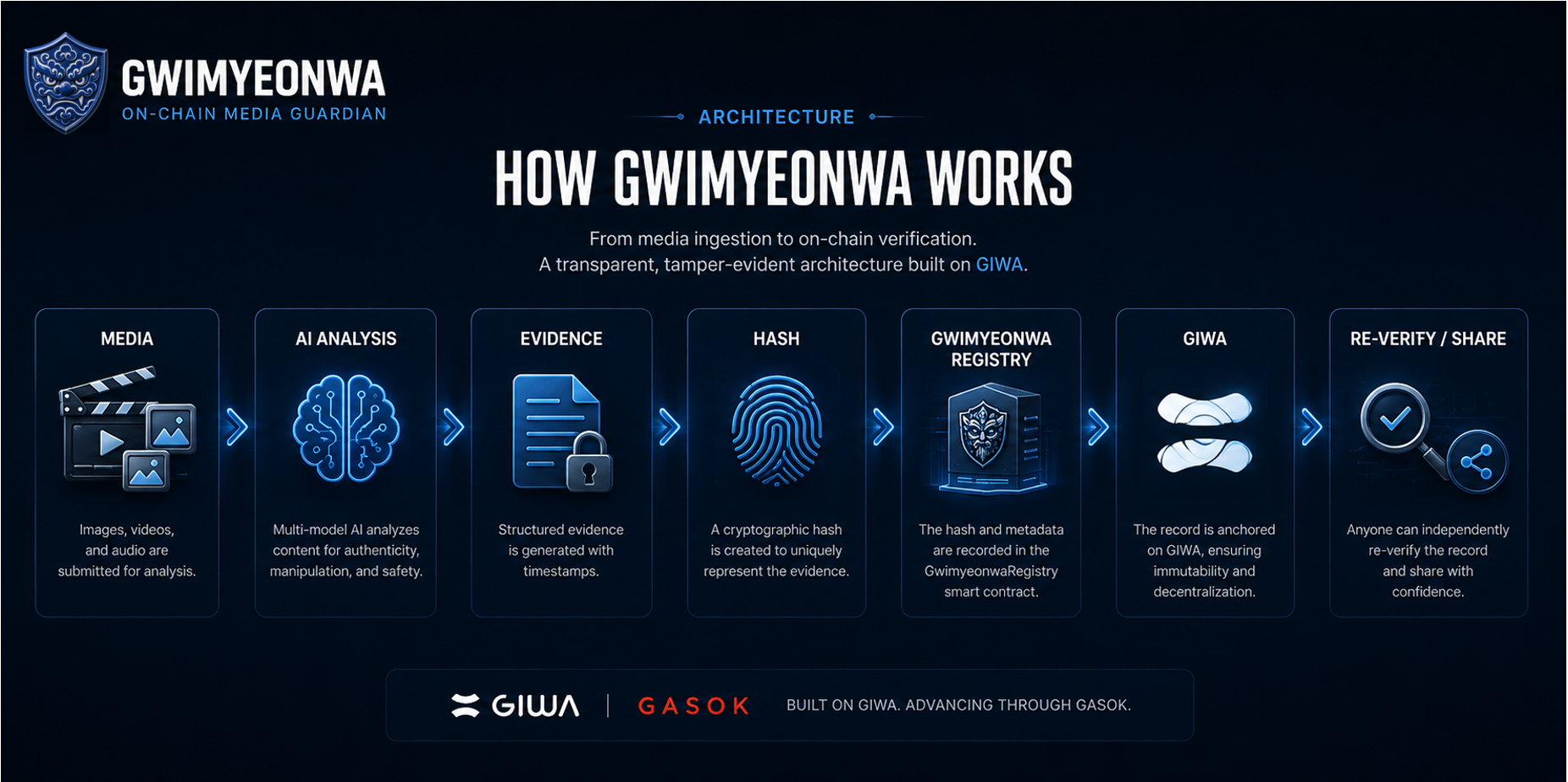
AI analyzes the media.
Cryptography fingerprints the evidence.
GIWA anchors the record.
The underlying product architecture is designed around precisely this transition: turning analysis into tamper-evident, shareable, and reusable on-chain proof.
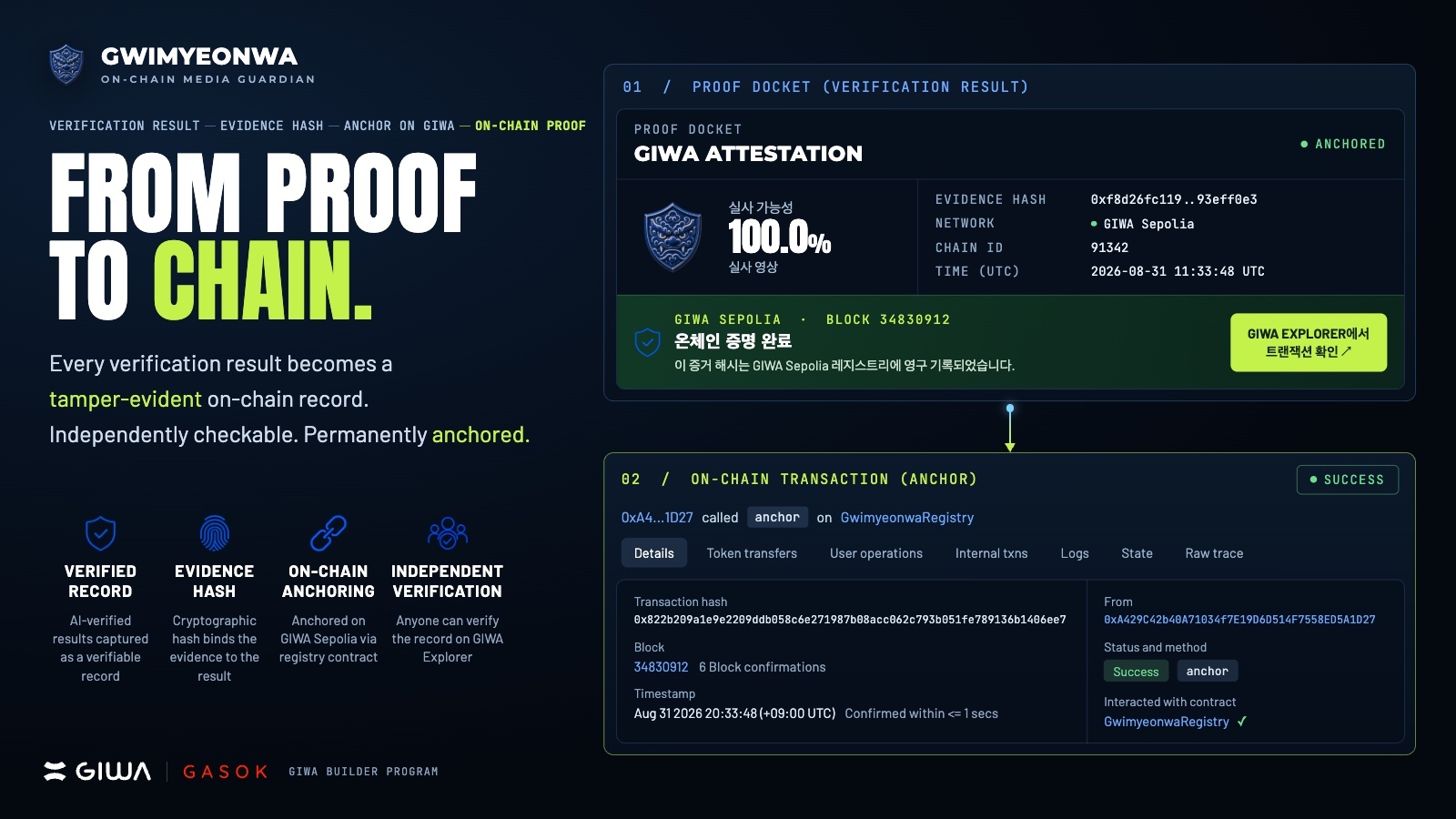
Verify
After the evidence has been anchored, the verification trail becomes inspectable on GIWA.
A user can see the evidence hash, network, chain ID, timestamp, and associated on-chain transaction.
They can then follow that record from GWIMYEONWA directly to the GIWA explorer.
This is where the difference between claiming verification and making verification inspectable becomes tangible.
GWIMYEONWA does not simply display:
“Verified.”
It gives users a path to check the record themselves.
What does the blockchain actually prove?
This distinction matters.
Putting a hash on a blockchain does not make an AI model infallible.
GIWA does not itself determine whether a video is a deepfake, AI-generated, manipulated, or unsafe.
The analysis layer makes those assessments.
What the blockchain can help establish is something different:
This particular verification record existed in this form at this point in time, and modifying the underlying evidence would change its cryptographic fingerprint.
That is why GWIMYEONWA is better described as combining AI media verification with on-chain proof, rather than claiming that blockchain itself proves whether media is true or false.
The objective is not to replace one black box with another.
It is to make the verification trail more durable and independently inspectable.
Why GIWA?
If every verification result remains entirely inside one company's database, then verifying the verifier eventually comes down to trusting that same company.
GWIMYEONWA uses GIWA to reduce that dependency.
The computationally intensive work — analyzing videos, detecting AI generation, deepfakes, manipulation, and unsafe content — remains off-chain.
The integrity record can be anchored on-chain.
This creates the foundation for verification evidence that can eventually be referenced beyond the GWIMYEONWA website itself: through links, wallets, APIs, applications, or services that need to check the status of an existing proof.
That is where the longer-term opportunity becomes larger than a single media-analysis interface.
A verification result can become portable trust data.
GWIMYEONWA's internal product architecture reflects this directly: GIWA functions as the settlement, ownership, and distribution infrastructure underneath reusable verification proofs.
Why the name GWIMYEONWA?
The idea behind the product begins long before AI or blockchain.
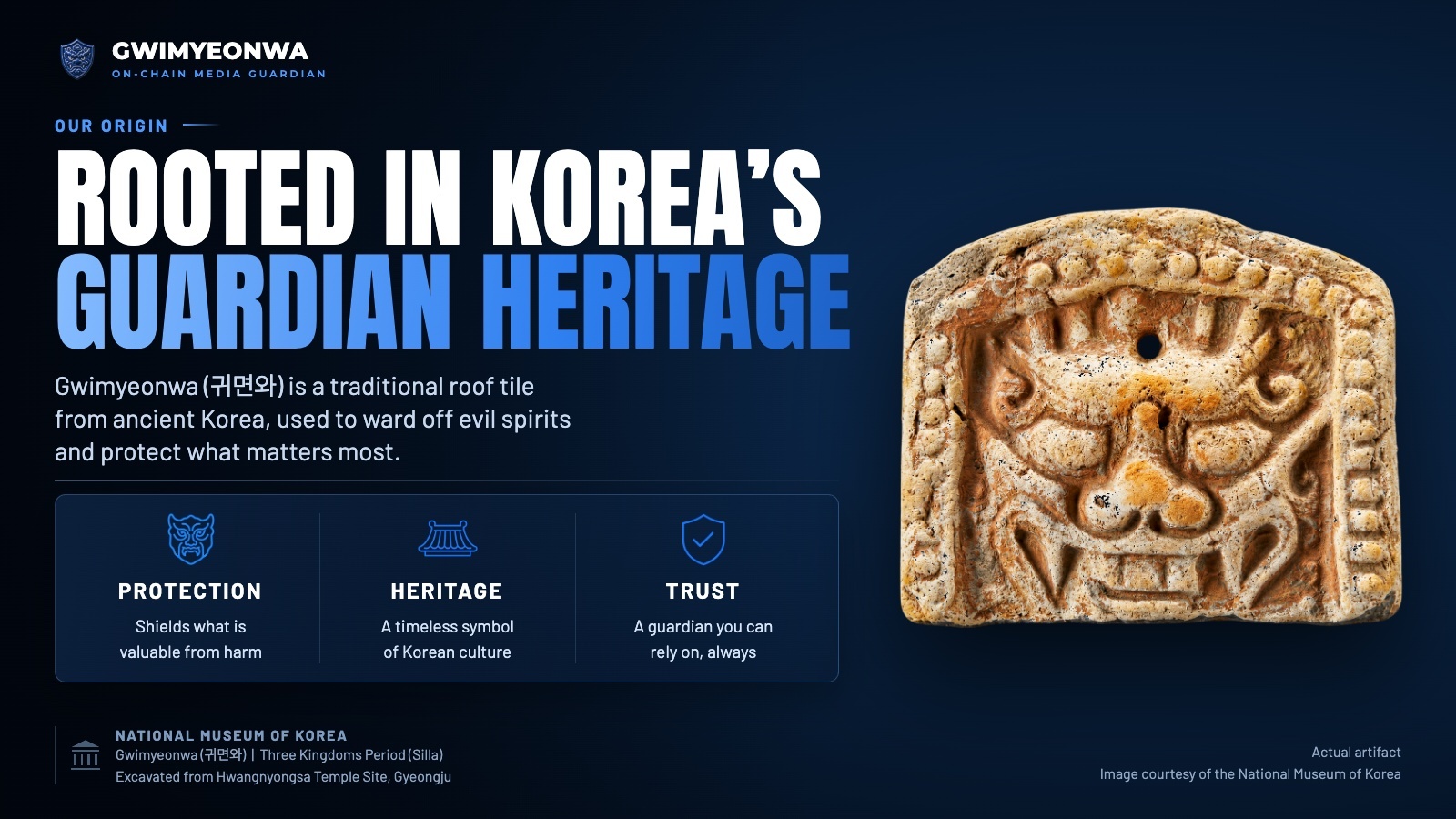
귀면와 — Gwimyeonwa — is a traditional Korean architectural tile marked by a fierce guardian face.
Placed around roofs and architectural boundaries, the imagery was associated with warding off harmful forces and protecting the space within.
We saw a natural parallel with digital media.
For centuries, the traditional Gwimyeonwa stood at the boundary of a physical space as a symbol of protection.
Today, the boundary has changed.
The threats are different.
AI-generated videos, deepfakes, manipulation, and unsafe content now move through digital environments at enormous speed.
So we brought the idea of the guardian tile into the digital world.
Once, it guarded rooftops.
Today, it guards digital media.
From GASOK to a media trust layer
Our acceptance into GASOK represents the next stage for GWIMYEONWA.
The core technical loop is already visible today on GIWA Sepolia:
Upload → Analyze → Generate Evidence → Hash → Anchor → Verify
Now the challenge is productization.
That means making verification easier to share and re-check. Making proofs useful beyond a single interface. Building APIs and workflows for platforms and organizations. Measuring repeated verification behavior. Hardening the underlying registry and proof architecture. And ultimately determining how GWIMYEONWA can become part of a broader media trust layer inside the GIWA ecosystem.
GWIMYEONWA's GASOK roadmap already points toward this evolution: from the current Sepolia MVP toward repeatable proof issuance, wallet-oriented distribution, design partners, API workflows, and eventual production readiness.
Because as synthetic media becomes increasingly difficult to distinguish from reality, one question will no longer be enough:
“What does the AI think?”
We will also need to ask:
Where is the evidence?
When was it verified?
Has that record changed?
Can I verify it myself?
GWIMYEONWA is being built for that world.
GWIMYEONWA
AI-generated video. Deepfakes. Manipulation. Unsafe content.
Detect the signal.
Preserve the evidence.
Verify the record.
Built on GIWA. Advancing through GASOK.