AI verification has a trust problem of its own.
Suppose an AI system analyzes a video and tells you:
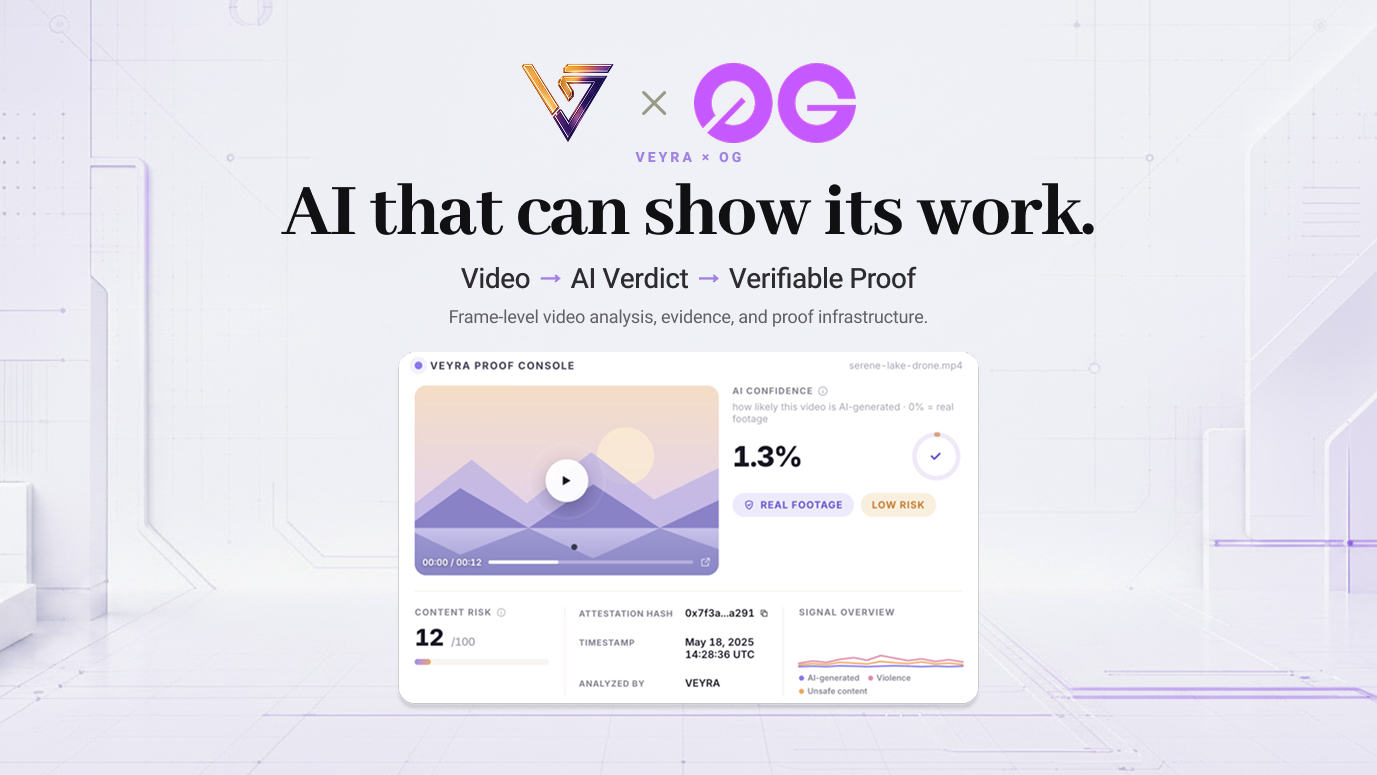
REAL FOOTAGE
LOW RISK
That answer may be useful.
But it immediately raises another question:
Who verifies the verifier?
If the only evidence behind an AI decision is a score displayed inside the same application's dashboard, the user is still being asked to trust the system making the claim.
We built Veyra around a different idea.
The AI verdict should not be the end of the verification process. It should leave evidence.
Veyra analyzes video frame by frame, evaluates whether the footage appears authentic or AI-generated, assesses content safety risk, and turns the result into a persistent proof record.
Our public product flow expresses it simply:
Analyze every frame → Two clear verdicts → Sealed as proof on 0G.
That architecture is why 0G became such a natural technical fit for what we wanted to build.
An AI score is useful.
An evidence trail is better.
Most AI verification systems begin with an input and end with a prediction.
A model analyzes a video.
A confidence score appears.
The system labels the footage authentic, synthetic, safe, or risky.
For many applications, that may be enough.
But as AI verification becomes part of higher-value workflows, we believe the standard needs to become higher.
If a platform, creator, brand, marketplace, or autonomous system relies on a verification result, several questions become important:
What media was actually analyzed?
What result did the system produce at that moment?
What evidence was associated with it?
Can that evidence still be retrieved later?
Can we detect if the record has been changed?
A confidence score by itself cannot answer those questions.
That is the problem Veyra is designed to address.
Start with the media itself
Veyra's first responsibility is AI analysis.
When a video is submitted, Veyra analyzes the footage frame by frame rather than treating the entire video as a single opaque input.
The system produces two primary outputs.
Authenticity
Does the footage appear authentic, or are there signals indicating that it is AI-generated or synthetic?
Content Risk
Does the footage contain unsafe or harmful material?
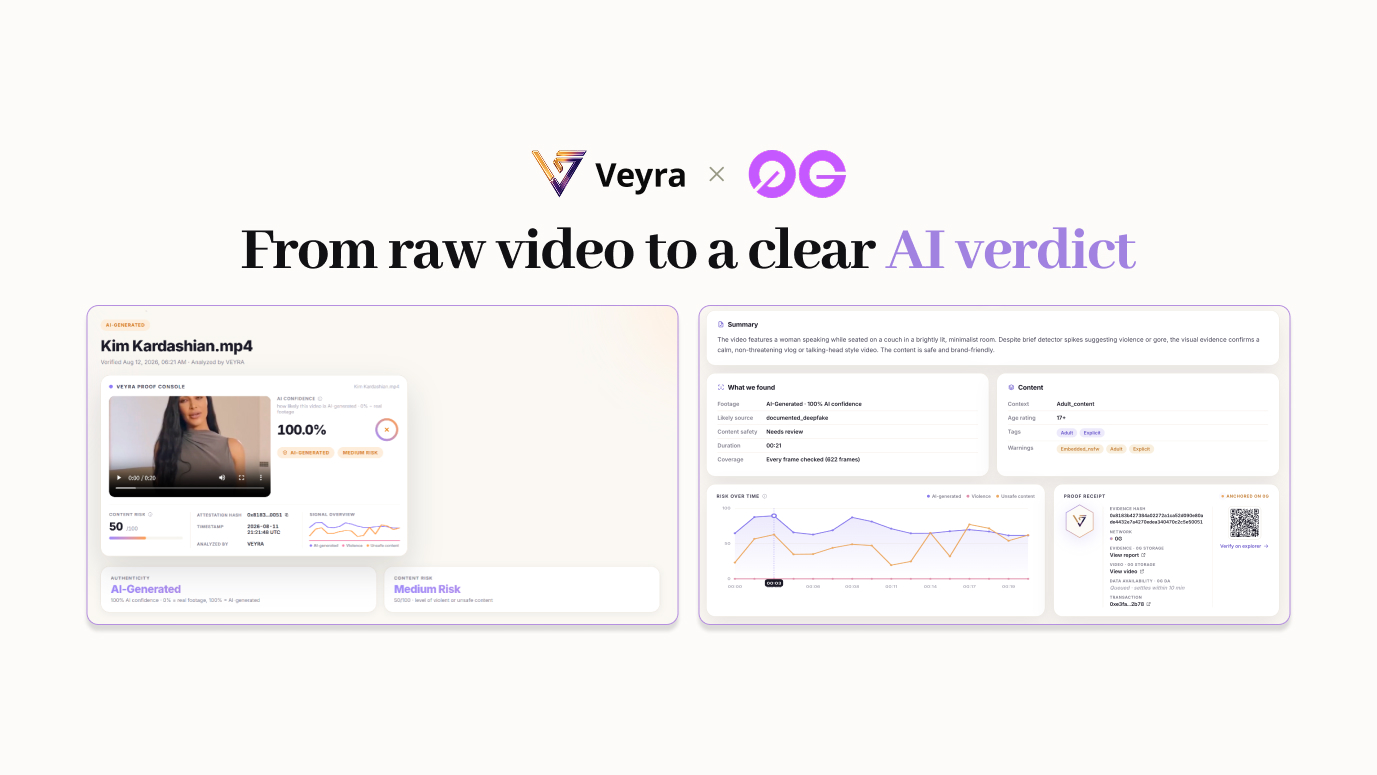
Veyra then presents those results in a form people can understand without having to interpret raw model output.
A proof can show a clear verdict such as:
REAL FOOTAGE
LOW RISK
alongside supporting information such as AI confidence, content risk, timestamps, signal data, and the resulting attestation.
But producing the verdict is only half of the system.
We could have built another centralized AI API.
We chose not to.
The easiest architecture for Veyra would have been straightforward.
Run inference on a conventional backend.
Store the result in our database.
Show the user a score.
Done.
But that would leave the most important part of the trust problem unresolved.
The verification would exist only because Veyra said it existed.
We wanted the result to have a life beyond our own database.
That created three separate infrastructure requirements:
somewhere to execute the AI analysis;
somewhere to persist the media and evidence;
and somewhere to anchor the integrity of the verification record.
This is where the 0G stack became fundamental to the architecture.
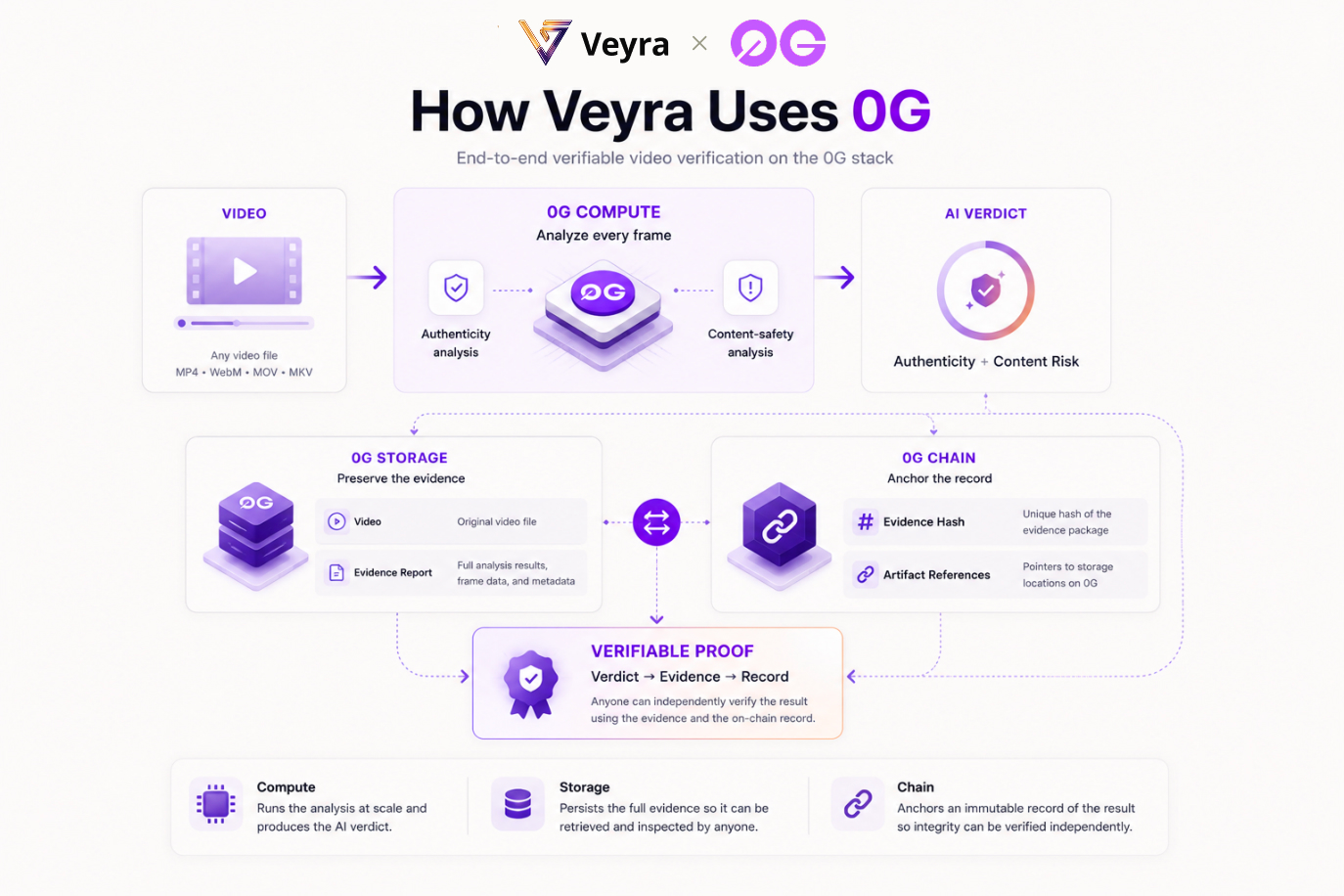
Veyra's public documentation presents the system as built end-to-end on 0G, across 0G Compute, 0G Storage, and 0G Chain.
0G is not simply where Veyra runs. It is part of how Veyra turns an AI judgment into a persistent, independently inspectable record.
What actually happens when Veyra verifies a video
The flow is intentionally simple.
1. A user submits a video : The video becomes the subject of a new verification.
2. 0G Compute runs the analysis : Veyra performs its frame-level authenticity and content-safety analysis using 0G Compute.
3. Veyra produces the verdict and evidence : The analysis is converted into understandable authenticity and safety results, along with the evidence associated with the verification.
4. The evidence is persisted through 0G Storage : The analyzed video and the full evidence report are stored through 0G Storage, giving the proof persistent artifacts to reference.
5. A compact attestation is anchored on 0G Chain : Rather than placing the entire video or report on-chain, Veyra anchors a compact record containing the evidence hash and references required to connect the verification to its underlying artifacts.
6. The user receives a proof receipt : The resulting verification connects:
the verdict
to
the evidence
to
the stored artifacts
to
the on-chain record.
The outcome is no longer simply an AI classification.
It is an AI classification with a retrievable evidence trail.
0G Compute — where the decision begins
Every Veyra verification starts with computation.
The system needs to examine the video, evaluate signals across its frames, and produce its authenticity and safety assessments.
That workload runs through 0G Compute.
0G's broader Compute network is designed as decentralized AI infrastructure connecting applications with compute providers rather than binding developers to a single centralized GPU provider. Its developer stack supports AI inference as a first-class workload.
For Veyra, the immediate role is clear:
0G Compute is where the AI analysis happens.
But computation alone is not enough.
Once the inference finishes, we need the evidence behind the decision to persist.
0G Storage — where the evidence lives
A verification result becomes significantly less useful if its supporting evidence disappears after the API request ends.
Veyra therefore uses 0G Storage for the analyzed video and its associated evidence report.
That distinction is important.
The video is the object being verified.
The evidence report records what Veyra found.
The proof needs references to both.
0G's current developer documentation exposes dedicated Storage SDKs for storing and retrieving large datasets, making Storage part of the same broader infrastructure environment as its AI tooling.
For Veyra, this creates a persistent evidence layer underneath the verdict.
The result does not have to exist only as a temporary response in our application.
It can point back to the artifacts that support it.
0G Chain — where the record is anchored
The final piece is integrity.
Veyra does not put an entire video or evidence report directly on-chain.
Nor does the blockchain decide whether a video is authentic.
Instead, Veyra anchors a compact attestation — including the evidence hash and relevant references — on 0G Chain.
That distinction matters.
The AI performs the analysis.
Storage preserves the evidence.
The chain helps establish a tamper-evident reference to the evidence that existed when the proof was created.
The user can then move from:
Verdict
↓
Evidence Report
↓
Stored Media
↓
Evidence Hash
↓
On-chain Record
rather than being forced to trust whatever our application happens to display later.
Veyra's existing public product already surfaces this model through its verification flow, including Latest Verification on 0G, View full proof, and On-chain record.
What “verifiable” means — and what it does not mean
We think this distinction is important enough to state explicitly.
Putting evidence on-chain does not make an AI model infallible.
AI models can still make mistakes.
Detection methods will continue to improve.
Confidence scores can evolve.
No blockchain transaction can magically establish that an AI classification represents absolute truth.
That is not what Veyra's proof layer claims to do.
The purpose of the architecture is more precise.
It helps establish:
what was analyzed;
what result was produced;
what evidence was associated with that result;
where that evidence can be retrieved;
and
whether the retrieved evidence still corresponds to the record that was anchored when the verification occurred.
The difference is important.
The chain does not decide whether the video is real.
It helps make Veyra accountable for the verification record it actually produced.
That is the kind of verifiability we believe is useful.
From “trust our result” to “check our evidence”
Consider two verification systems.
System A
You upload a video.
The API returns:
2.4% synthetic probability
LOW RISK
Six months later someone asks for evidence supporting the decision.
The answer is:
“Our database says that was the result.”
System B
You upload the same video.
The AI produces the same verdict.
But the verification also produces:
the analyzed-media reference;
the evidence report;
persistent artifact locations;
the evidence hash;
the timestamped attestation;
and an independently inspectable on-chain record.
The AI has not suddenly become perfect.
But the verification event has become more accountable.
That is the transition we are building toward with Veyra.
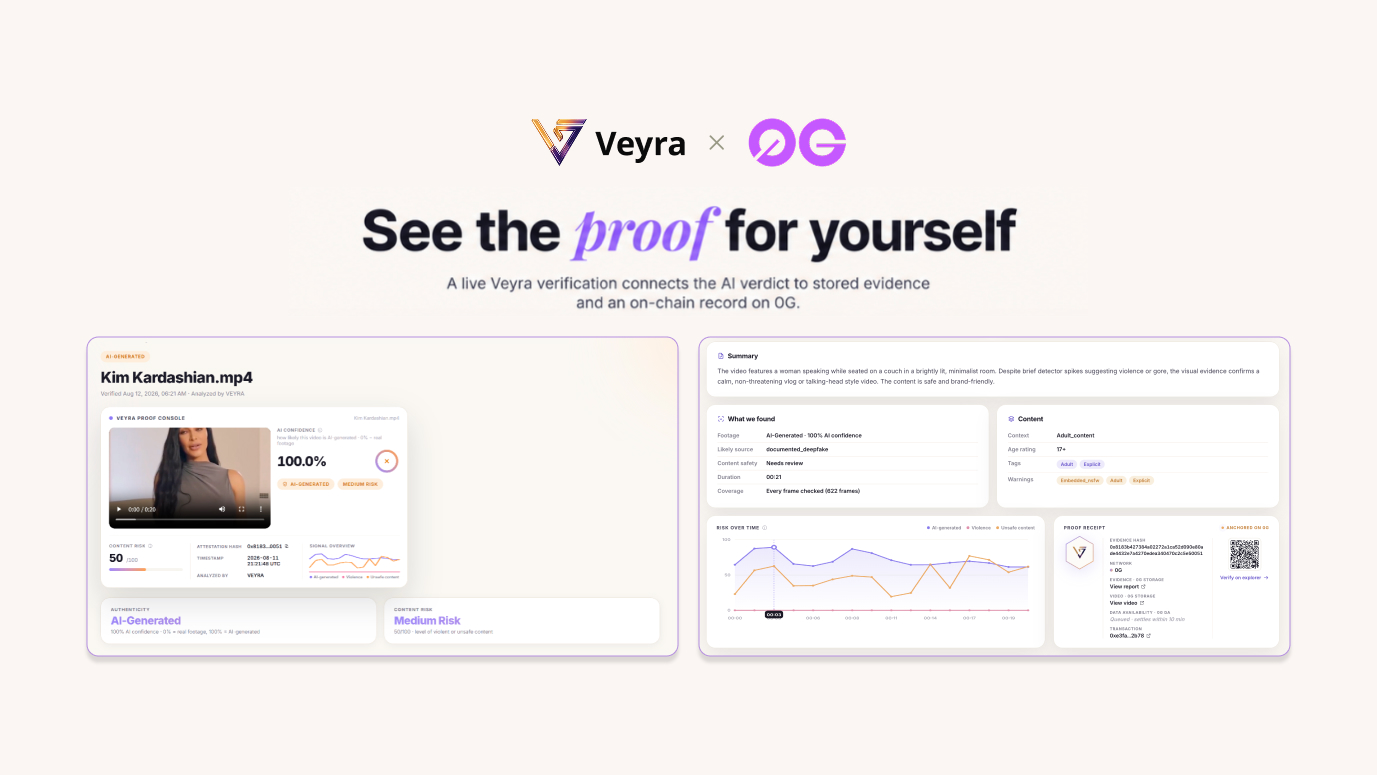
Verification can go deeper than the output
Building Veyra has also made us think about a second layer of the trust problem.
Today, Veyra is focused on making the result and evidence trail of an AI verification more inspectable.
But eventually there is another question:
Can we obtain stronger guarantees about the computation that produced the result itself?
That is one reason the broader direction of 0G is particularly interesting to us.
0G Private Computer is extending the stack toward verifiable and private AI execution.
Its current architecture exposes different trust modes depending on the workload. Verified Routing restricts requests to verifiable providers, while Private Inference can route workloads to TEE-backed environments where sensitive computation is isolated. Verified and private requests are cryptographically signed, with 0G working toward a dedicated Proof ID that can be independently checked.
Recent 0G deployments also demonstrate multiple verification models in practice. For example, 0G distinguishes between TEE-hosted inference and TeeTLS-attested routing to external model providers rather than claiming that every model receives the same guarantee.
We appreciate that technical precision.
And we see a compelling longer-term progression for products such as Veyra.
Today:
Can someone inspect the evidence behind Veyra's decision?
Over time:
Can someone also obtain stronger guarantees about how the AI producing that decision was executed?
Those are different levels of verification.
Together, they point toward something much more powerful.
Why 0G is such a strong technical fit for Veyra
The strongest infrastructure partnerships are not the ones where a product simply adds a network logo to its footer.
They are the ones where the infrastructure changes what the product is capable of doing.
That is what happened with Veyra.
0G Compute gives us the AI execution layer.
0G Storage gives the evidence somewhere persistent to live.
0G Chain gives that evidence an integrity anchor that can be independently inspected.
Together, those layers allow us to build something fundamentally different from a conventional AI moderation or detection API:
a verification system where the decision can leave a durable evidence trail.
That is also why we describe Veyra as built end-to-end on 0G rather than simply “using blockchain.”
The architecture is not blockchain added after the product was finished.
Different parts of the 0G stack participate in different stages of the verification itself.
For us, that is a much more meaningful infrastructure relationship.
The technology matters.
The team behind it does too.
There is another reason we have enjoyed building Veyra with 0G.
The 0G team has been genuinely exceptional to work with.
They have been responsive when technical questions came up.
They have been thoughtful when we were working through architecture.
And most importantly, they have been willing to engage with what we were actually trying to ship — not simply whether we could technically call an API.
That makes a significant difference for a product team.
Documentation matters.
APIs matter.
Infrastructure matters.
But real products inevitably create questions that do not fit neatly inside documentation.
The best infrastructure teams understand that.
They help builders turn primitives into products.
That has consistently been our experience with 0G.
The technical alignment made 0G a strong infrastructure fit for Veyra.
The experience of working with the team made us want to keep building together.
AI that can show its work
Veyra started with a straightforward product question:
Can AI help determine whether video is authentic and safe?
Building the product led us to a more important one:
How do we make that decision something other people can inspect instead of simply trust?
Our answer is:
Analyze every frame.
Return understandable verdicts.
Preserve the underlying evidence.
Anchor the integrity of the record.
Give users a path to inspect it themselves.
That is what the combination of Veyra and 0G enables us to build today.
And as the 0G stack continues developing stronger guarantees around the compute layer itself, we see an opportunity to take verifiable AI much further.
The future of AI verification should not be another black box telling us which other black boxes to trust.
It should be infrastructure that makes AI systems progressively more accountable.
Don't trust the verdict.
Verify the evidence.
AI will increasingly participate in decisions about the media we create, publish, consume, and distribute.
As those decisions become more consequential, we believe the systems making them should be held to a higher standard.
Not simply:
“Trust us.”
But:
“Here is what we analyzed.”
“Here is what we found.”
“Here is the evidence.”
“Here is the record.”
“Check it yourself.”
That is the idea behind Veyra.
And it is why 0G is such a natural infrastructure partner for what we are building.
AI shouldn't only make decisions.
AI should be able to show its work.
We are excited to keep building toward that future with 0G.
Explore
Try Veyra → https://veyra.holostudio.io/
Read how Veyra works → https://veyra.holostudio.io/docs
View a live Veyra proof on 0G → https://veyra.holostudio.io/v/99aa329a
Inspect the on-chain record → https://chainscan.0g.ai/tx/0xe3fa4e819545cbc3a0396df830a8c4ac2eed05962f2c644a04983164a8392b78
Explore 0G → https://0g.ai/
Veyra × 0G
Video → Verdict → Evidence → Proof
Built by Holo Studio. Built end-to-end on 0G.