Building PlayArts has changed the way we think about AI infrastructure.
To the user, the experience should feel simple:
Select an IP → Write a prompt → Generate a consistent video.
Behind that simple interaction is a much harder infrastructure problem.
AI video generation is compute-intensive. As generation quality increases, sequences get longer, models become more capable, and more users create at the same time, the infrastructure underneath the product starts to matter just as much as the model itself.
But scale is only one part of the question.
As AI becomes responsible for more valuable outputs and increasingly sensitive workloads, we think developers will need to ask more of the compute layer:
Which model actually ran?
Where did it run?
Can the execution be independently verified?
What happens when the input itself is sensitive or proprietary?
Those questions are a major reason we have become increasingly interested in what 0G is building across Compute and Private Computer.
For us, this is no longer simply about finding more GPUs.
It is about what the execution layer for the next generation of AI applications should look like.
Compute should be infrastructure, not a constraint
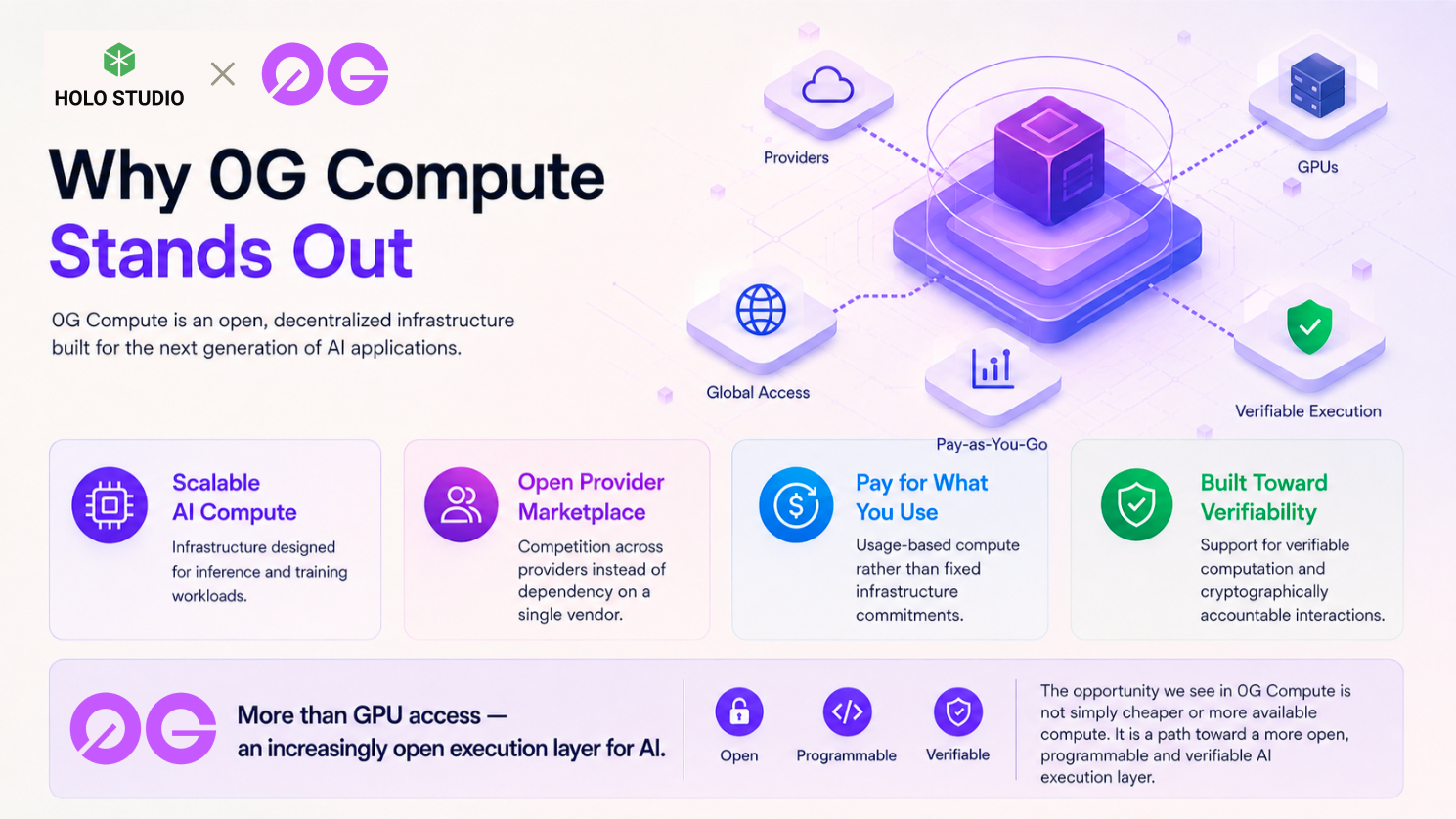
0G Compute takes a fundamentally different approach from the traditional single-cloud model.
Rather than tying developers to one centralized provider, 0G describes Compute as a decentralized marketplace connecting developers who need AI computing power with GPU providers that can supply it. The network is designed around competitive provider pricing, pay-per-use consumption, automatic provider selection and smart-contract-based settlement.
That architecture is immediately interesting to us.
AI products rarely have static compute requirements.
A product may need one type of model today and another tomorrow. Demand can change quickly. New workloads can appear as the product evolves. And developers should not have to redesign an application every time they want to change how inference is supplied.
0G's model creates a different possibility: compute as an open marketplace rather than a fixed dependency on a single vendor.
The official 0G documentation also describes support for traditional applications through REST APIs and the 0G SDK, alongside blockchain-native integrations. For application developers, that matters because decentralized infrastructure is only useful if integrating it does not become the entire engineering project.
But the part that interests us most goes beyond access and pricing.
The next problem is not more compute.
It is more trustworthy compute.
If AI infrastructure stopped evolving at “more GPUs for less money,” we would be missing the more important opportunity.
The next generation of AI applications will increasingly take actions that matter.
Agents will interact with financial systems. Models will process proprietary company information. AI applications will handle creative IP, personal data and sensitive business context. Automated systems will make decisions that users may eventually need to audit.
At that point, a traditional black-box API creates a difficult trust model:
We send a request.
Someone tells us what model handled it.
A result comes back.
We trust that everything happened as described.
We think that model becomes less acceptable as the value and sensitivity of AI workloads increase.
This is where 0G Private Computer becomes particularly interesting.
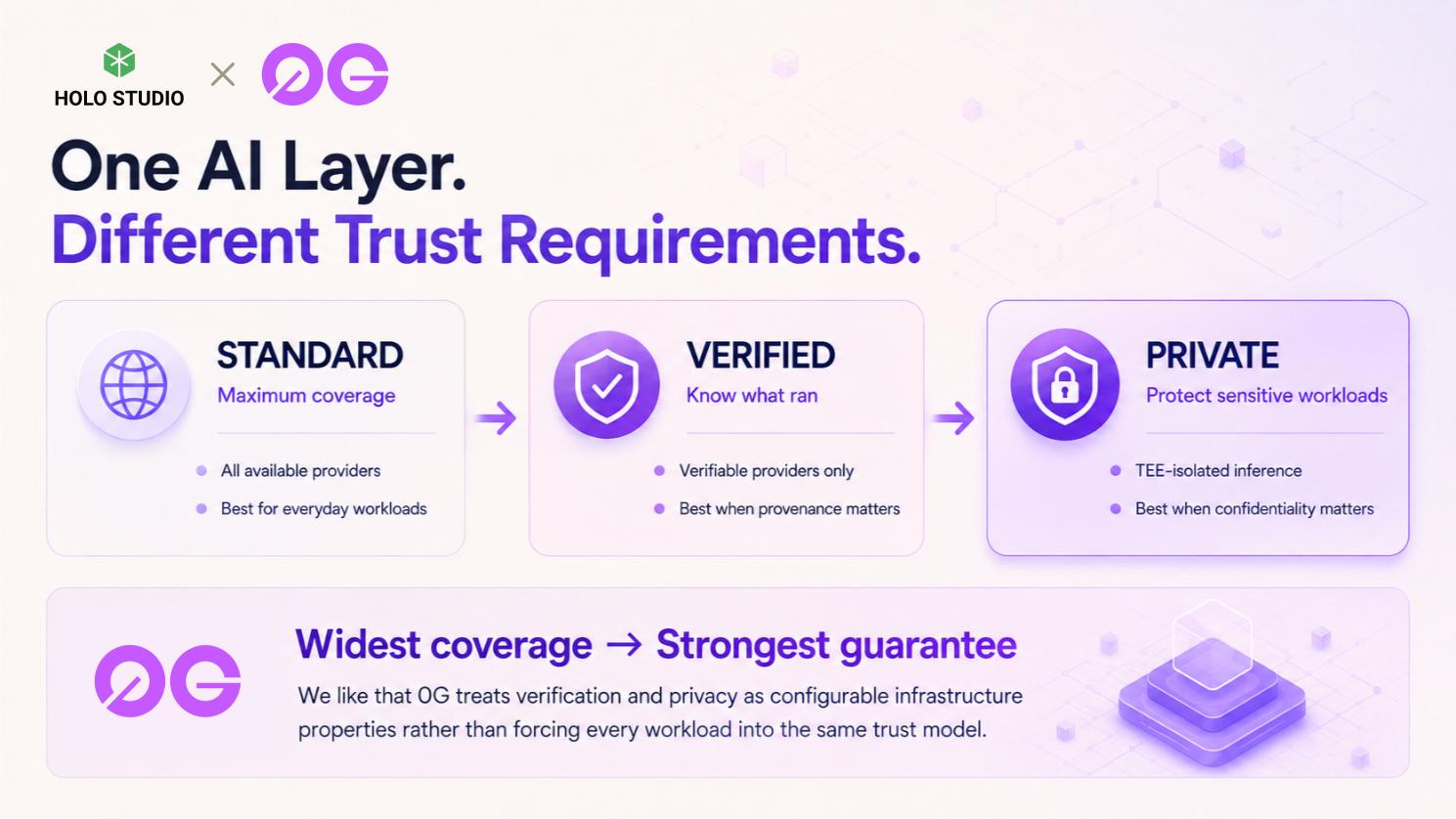
0G currently positions Private Computer around three trust modes: Standard, Verified and Private. Standard Routing prioritizes broad provider coverage and availability. Verified Routing restricts requests to verifiable providers, while Private Inference routes workloads to TEE-backed providers designed to keep sensitive execution isolated.
The distinction is important.
Not every AI request needs maximum privacy.
Not every request needs the same level of verification.
What we like about the architecture is that trust becomes something the application can choose according to the workload.
A routine request can prioritize coverage.
A higher-value request can require verifiable execution.
A sensitive request can require private, enclave-based inference.
And 0G has designed switching between these modes to require minimal application changes: trust mode can be configured at the API-key level or selected for individual requests.
That is the kind of abstraction we want AI infrastructure to move toward.
“Don't trust. Verify.”
is more than a good slogan
What makes this direction especially compelling is the effort to turn execution claims into something a developer can actually check.
For Verified and Private requests, 0G says inference responses are cryptographically signed. Its verification design is intended to allow applications to independently check elements such as the attestation signature, model identity, enclave measurement and routing path. 0G currently notes that a dedicated Proof ID is still coming, which is an important distinction between what is live and what is still being completed.
We appreciate that distinction.
Verifiable AI should not itself be built on vague claims.
The direction matters because it changes an AI application's relationship with infrastructure.
Instead of:
“The provider says the correct model ran.”
we move toward:
“The application can obtain evidence about what actually ran.”
Instead of:
“The provider promises not to inspect sensitive data.”
private inference can increasingly rely on hardware-isolated execution designed so that neither the platform nor the underlying provider can access the workload in plaintext.
This is a fundamentally more interesting foundation for serious AI applications.
Why this matters for PlayArts
PlayArts currently focuses on a creative problem:
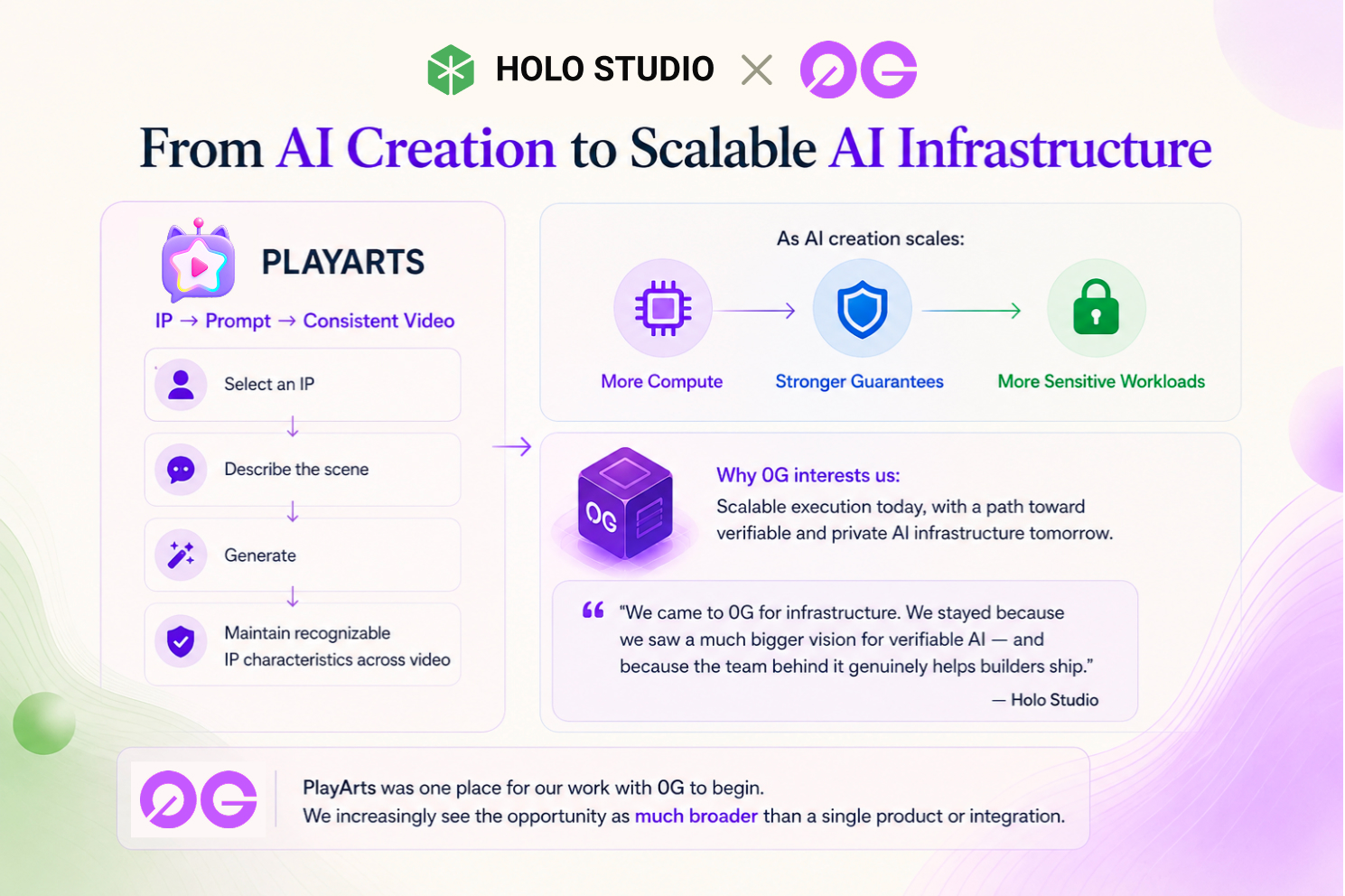
How can someone select an IP, express an idea through a prompt, and generate video while maintaining the recognizable characteristics of that IP?
Today, that means making AI creation more consistent and useful.
But we think about where the product could go next.
As AI creation becomes more sophisticated, the underlying infrastructure requirements grow with it.
More generation means more compute.
Longer and higher-quality video means heavier workloads.
More creators means more concurrency.
And deeper participation from brands, creators and IP owners may eventually introduce a different requirement entirely:
privacy and stronger execution guarantees.
A brand may not want proprietary creative inputs exposed unnecessarily.
An IP owner may care about which models process protected assets.
A commercial workflow may need more confidence about where and how an inference was executed.
These are not claims about every PlayArts workflow today.
They are the infrastructure problems we expect products like PlayArts to encounter as AI creation matures.
That is why we see 0G Compute as more than a source of inference capacity.
We see the potential for a broader execution layer where applications can scale compute first — and introduce stronger verification and privacy guarantees as particular workloads require them.
That flexibility is compelling.
The infrastructure brought us in.
The team made us want to keep building.
There is another part of our relationship with 0G that does not appear in an architecture diagram.
The team has been exceptional to build with.
That deserves to be said publicly.
Throughout our work together, the 0G team has consistently been responsive when we had technical questions, thoughtful when we were working through architecture decisions, and genuinely willing to help us understand how the technology could fit into real products.
They did not simply point us toward documentation and leave us to figure out the rest.
They engaged.
They answered questions.
They helped us think through integrations.
And when we were trying to move from an idea toward something users could actually interact with, they cared about helping us get there.
For a team shipping products quickly, that makes a meaningful difference.
There are many infrastructure companies with APIs.
There are many networks with technical documentation.
But we have learned that the quality of the people behind the infrastructure can be as important as the infrastructure itself.
Great infrastructure gives builders powerful tools.
Great infrastructure teams help builders turn those tools into real products.
That has been our experience with 0G.
And it is one of the biggest reasons we are interested in expanding the relationship rather than treating this as a one-off integration.
What excites us most is where the stack is going
0G Compute already provides a decentralized marketplace for AI inference and training, with usage-based consumption and a provider network underneath it.
Private Computer adds another layer to that thesis.
Its current product surface emphasizes three things we think will become increasingly important in AI infrastructure:
Proof. Privacy. Price.
Verified Routing is designed to give applications stronger confidence that the requested model actually ran through a verifiable provider.
Private Inference introduces TEE-isolated execution for workloads where confidentiality matters.
Open provider competition creates an alternative to the economics of a single centralized vendor.
What is particularly encouraging is that these ideas are not presented only as research concepts.
Private Computer is available as an API product today, with an OpenAI-compatible interface and a growing model catalog. 0G describes the developer experience as deliberately minimizing switching cost so existing applications can adopt the infrastructure without rebuilding their entire inference stack.
That matters to builders.
The best infrastructure innovation is often the kind that introduces a new capability without asking developers to abandon everything they already know.
The compute layer we want for the next generation of AI
We do not know exactly what every AI application will look like three years from now.
Nobody does.
But we have a strong view about the infrastructure those applications will need.
They will need scale.
They will need choice.
They will increasingly need privacy.
And for higher-value AI activity, they will need stronger ways to answer a simple question:
Did the system actually do what it claims it did?
That is why we are paying close attention to the direction 0G is taking.
PlayArts gave us one reason to start thinking deeply about compute.
What we see in 0G is a much bigger thesis:
AI infrastructure should not only provide more computation. It should progressively provide stronger guarantees about the computation itself.
That is a future we want to build toward.
And we are fortunate to be building alongside a team that has been genuinely committed to helping us get there.
This is only the beginning
Our work with 0G started with specific technical needs.
It is becoming a broader conversation around what Holo Studio's AI infrastructure should look like across creation, verification and other products we are building.
For PlayArts, we see significant potential in scalable AI execution.
For future workloads, we are increasingly interested in verifiable and privacy-preserving inference.
And across all of it, we have found a partner whose team has consistently shown up when builders need help turning technology into something real.
So this article is partly about 0G Compute.
It is partly about Private Computer.
But more than anything, it is about why we believe the relationship is worth expanding.
We came to 0G for infrastructure.
We stayed because we saw a bigger vision for verifiable AI — and because the people behind it genuinely help builders build.
We are excited for what comes next.
Explore
PlayArts — IP-driven AI video creation
0G Compute — decentralized infrastructure for AI inference and training
0G Private Computer — verifiable and private AI inference
Holo Studio × 0G
Building what comes next.